
Is Your Paperwork Causing You Anxiety?
Is your filing cabinet full, but not actually filed?
Do you close your desk drawers rather than deal with what’s inside?
Do you add another piece of paper to the pile, or put unopened envelopes to one side, telling yourself you’ll deal with them later?
Paperwork is one of those things that can quickly become clutter because we’re often afraid to throw something away just in case. And before you know it, you have piles of paperwork in different places around the house, a filing cabinet you don't want to open and no idea where that important document is when you actually need it.
So, where do you start?
Start by sorting your paperwork into four broad categories, action, file, shred, recycle. Use sticky notes and marker pens when you're sorting. Label your piles clearly.
Action
Anything that needs your attention: bills to pay, forms to complete, letters to respond to or appointments to arrange.
Quick Wins - If something will only take a few minutes, do it immediately.
If it’s going to take longer, put a sticky note on it and schedule some time in your diary to deal with it.
File
Things you need to keep for the longer term.
For example:
- Passports and identity documents
- Medical records and information
- Insurance documents
- Financial documents
- Property documents and title deeds
- Mortgage information
- Tax records
- Car documents
- Certificates and qualifications
You don't need to decide exactly where everything is going to live straight away. The first step is simply working out what needs to be kept. Money Saving Expert's Martin Lewis has some guidance on how long you should keep bank statements, digital documents and paperwork. How long should you keep bank statements, digital documents and paperwork?
Shred
Old documents that are no longer needed but contain personal or sensitive information.
Anything with personal information should be disposed of securely. For particularly sensitive documents, shredding is the safest option.
Recycle
Things that don't need to be kept at all, old to-do lists, expired coupons, flyers and general paper clutter. For documents that don't need shredding but still contain personal details, I like to use an identity protection roller stamp before putting them in the recycling.
I use a Confidential Roller Stamp and keep it close to the front door, so I can deal with paperwork as soon as I’ve opened it.
Don't make your filing system too complicated
There are lots of ways to organise paperwork.
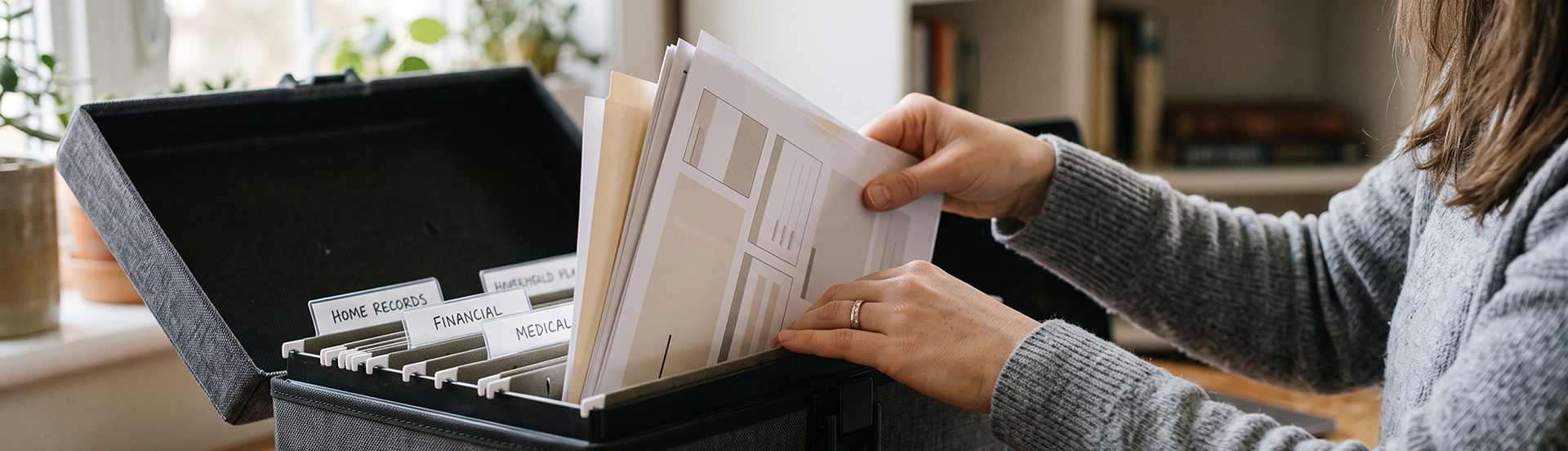
You might prefer a filing cabinet with labelled suspension files, box files or an accordion file organiser.
You could have broad categories such as:
- Home
- Gas & electricity
- Water
- Council tax
- Insurance
- Broadband
- Car
- Medical
- Personal
There isn't one right system. Don't make it so complicated that you have to think about where something belongs every time you need to file it. Broad categories are often enough.
The best filing system is the one that makes sense to you and that you will actually use.
Could you go paperless?
If possible, go paperless for things like bank statements, bills and regular correspondence.
Opting in to electronic statements can dramatically reduce the amount of paper coming into your home. And if you don't have to deal with it in the first place, it can't become another pile!
It’s not about perfection
Getting your paperwork organised isn't about creating a perfect filing system or having a beautifully organised filing cabinet. It’s about making things easier to find, easier to deal with and less overwhelming. It’s also about getting your affairs in order and making things easier for yourself and for the people who may need to help you in the future.
And once you've worked through those piles, you may find that you feel a little lighter too.
Less anxious. More in control.
And when you need that important document, you'll know exactly where to find it.
